

Sanford Housing Authority Held FSS Program Graduation, Submitted ROSS Program Grant, & Continues Self-Sufficiency Agenda
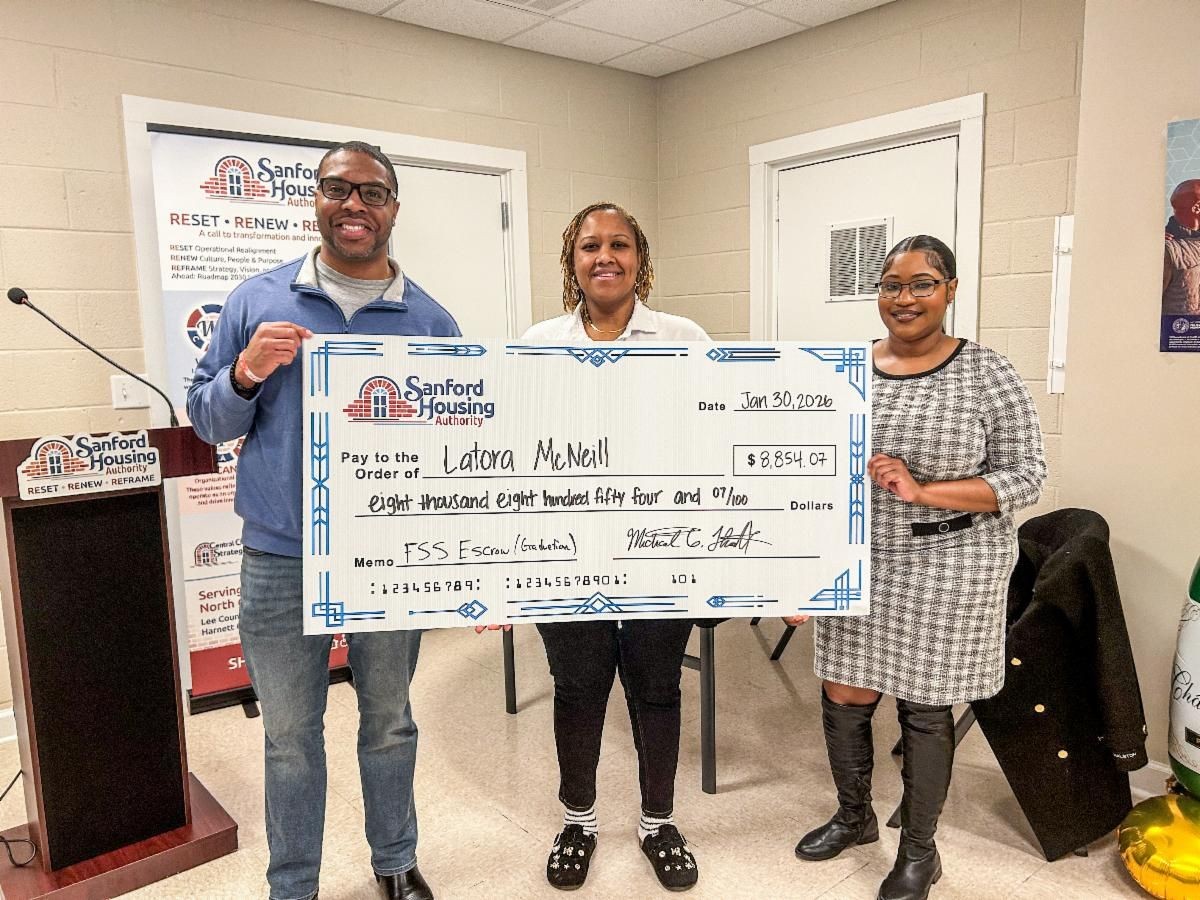
Latora McNeill_FSS Graduate_Sanford Housing Authority
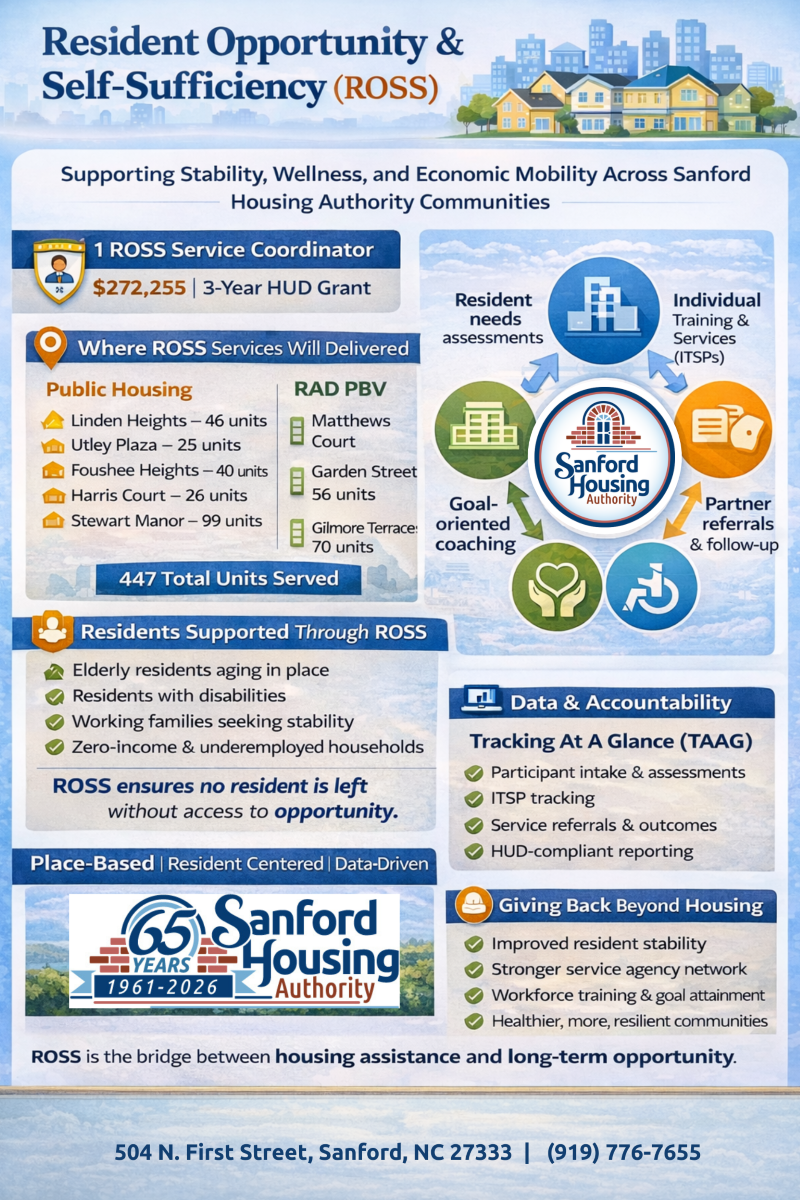
ROSS Program Grant Flyer
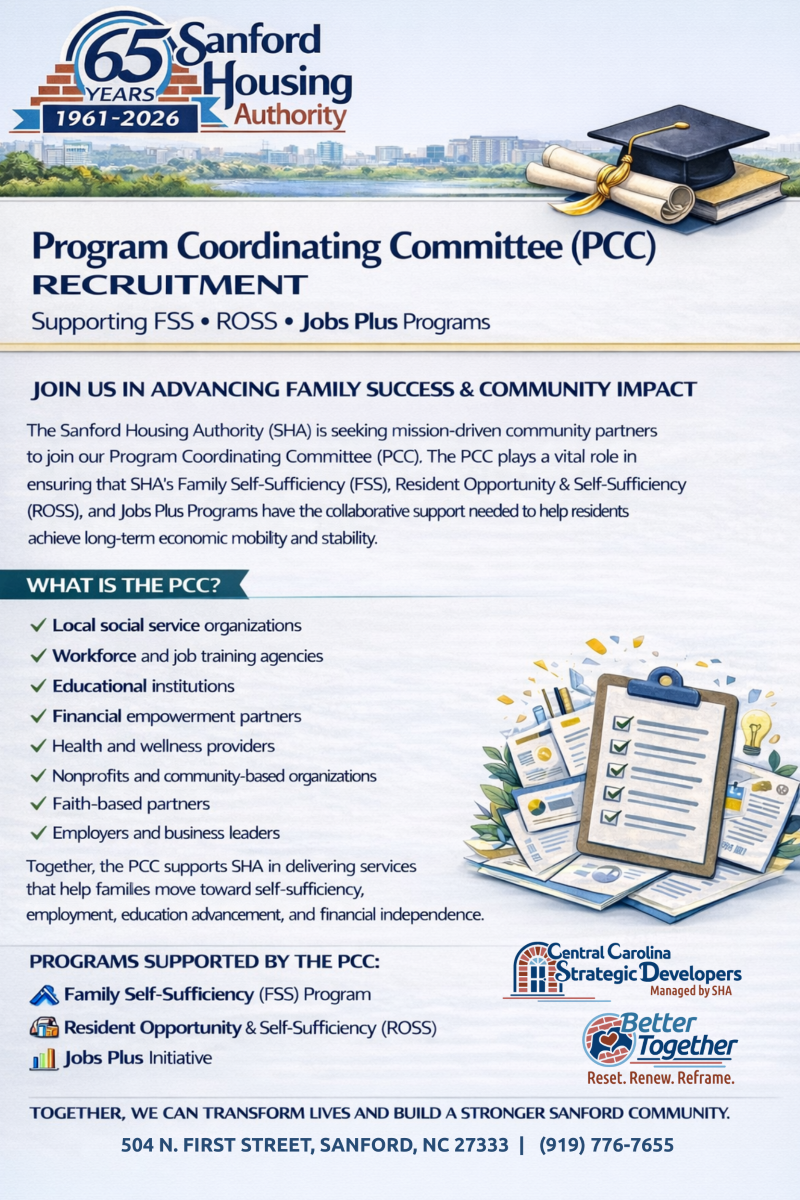
Program Coordinating Committee (PCC) Recruitment Flyer
SHA's CEO, Dr. Michael C. Threatt, Launches Program Coordinating Committee (PCC) Recruitment Campaign for Service Providers for FSS, ROSS, & Jobs Plus Programs
SANFORD, NC, UNITED STATES, February 9, 2026 /EINPresswire.com/ -- The Sanford Housing Authority (SHA) is advancing its resident-centered transformation with three pivotal developments: a milestone Family Self-Sufficiency (FSS) graduation on January 30, 2026; submission of a Resident Opportunity & Self-Sufficiency (ROSS) grant application; and the launch of a robust Program Coordinating Committee (PCC) recruitment campaign to expand services and partnerships across FSS, ROSS, and future Jobs Plus initiatives.
Under the leadership of Chief Executive Officer (CEO) Dr. Michael C. Threatt, SHA is executing a comprehensive self-sufficiency agenda aligned with its Roadmap 2030 strategic plan, prioritizing economic mobility, partnership-driven service delivery, and measurable outcomes that help families build assets and achieve independence.
A Standout Achievement: Latora McNeill Completes FSS in Just Over Two Years
SHA proudly celebrated Ms. Latora McNeill, who completed the FSS program in just over two years, well ahead of the program’s typical five-year timeframe. Her finish exemplifies what’s possible when personal perseverance meets high-quality case management, clear goal-setting, and strong community partnerships.
“The Family Self-Sufficiency Program is not a sprint; it’s a marathon. It’s not how you start; it’s how you finish. Ms. Latora McNeill was determined to reach her goals with tenacity and perseverance,” said Dr. Michael C. Threatt.
McNeill’s acceleration through the program was fueled by steady progress on education, employment, and homeownership readiness goals. She completed HUD-approved homebuyer education, strengthened her career trajectory with industry-recognized credentials, and leveraged financial coaching to position her household for long-term stability. In line with the FSS model, her earnings growth translated into escrow accumulation, providing a springboard for future investments such as down payment savings, business start-up costs, or continued education.
The graduation ceremony at the Gilmore Terrace Community Center showcased SHA’s renewed focus on resident outcomes, teamwork, and community engagement. The celebration also recognized the dedication of SHA’s resident services staff and partners who helped remove barriers, coordinate resources, and keep Ms. McNeill’s goals on track. Fidelity Bank and Premier Contracting Professionals sponsored the graduation ceremony.
FSS as a Mobility Engine: Coaching, Escrow, and Outcomes
SHA’s Family Self-Sufficiency program is designed to help Public Housing and Housing Choice Voucher (HCV) households increase earned income, reduce reliance on assistance, and grow financial assets. Participants work with coordinators to build Individual Training & Services Plans, tracking milestones such as job placements, wage increases, credit building, and debt reduction.
As income rises, FSS participants can accumulate escrow savings, a powerful incentive that rewards progress and creates an asset that can be used at graduation for life-changing investments. With an expanded team, including a supervisor and multiple coordinators, SHA has increased capacity to serve Public Housing, HCV, RAD PBV, and PBV families while driving quality improvements in case management, data tracking, and outcome reporting. The agency’s aim is clear: more enrollments, more completions, and more households exiting with the skills, savings, and confidence to chart their own path forward.
SHA Submits ROSS Grant to Strengthen On-Site Resident Services
Complementing its FSS momentum, including a $148, 624.00 grant renewal, SHA has submitted its ROSS grant application to scale on-site service coordination across its portfolio for a three-year term. The application requests $272,250 in HUD funding. The grant will fund one ROSS Service Coordinator focused on connecting residents, especially seniors and people with disabilities, to a coordinated network of supports, including workforce pathways, financial capability, digital inclusion, transportation linkages, health and wellness resources, and eviction prevention.
The ROSS initiative will serve SHA’s Public Housing, RAD PBV, and PBV communities by focusing on removing barriers and measuring progress toward self-sufficiency. The program design emphasizes coordinated referrals, consistent case management, and outcome tracking to ensure residents receive timely, needs-aligned services and that partners are synchronized around clear, resident-centered goals.
Key delivery partners and services include:
• Premier Contracting Professionals — Provides workforce and construction skills training to support employment readiness.
• Partnership for Children & Families — Offers family stabilization and health/wellness supports, including services that help parents reduce barriers to work and education.
• Life Springs Dream Center — Delivers life skills instruction, empowerment workshops, and support groups to help residents strengthen personal development and self-sufficiency skills.
Program Coordinating Committee (PCC): Recruiting Partners Across Sectors
To amplify impact, SHA is launching a PCC recruitment campaign to formalize and expand its partner ecosystem for FSS, ROSS, and Jobs Plus. SHA invites committed organizations to join the PCC and co-design a seamless referral network, shared curriculum, and coordinated service delivery model. Priority sectors include:
• Workforce & Industry: Employers, workforce development affiliates, apprenticeship programs, and trade associations
• Education & Training: Community colleges, adult education, literacy providers, and credentialing programs
• Financial Empowerment: Banks and CDFIs, credit counselors, homeownership supports, and tax preparation partners
• Health & Wellness: Clinics, behavioral health providers, and nutrition and fitness organizations
• Youth & Family Services: Nonprofits, faith-based partners, after-school programs, and mentoring organizations
• Reentry & Legal Aid: Courts, public defenders, reentry navigators, and expungement clinics
• Small Business Support: Chambers of commerce, SBDCs, entrepreneurship incubators, and coaching services
The PCC will meet quarterly to review outcomes, identify service gaps, align curricula with employer demand, and guide continuous improvement.
“Housing is the platform, but partnerships are the accelerator,” added Dr. Threatt. “Our PCC will transform resident services from a set of programs into a coordinated mobility ecosystem, so families experience one door, one plan, and one connected community working on their behalf.”
This approach echoes SHA’s I CAN organizational values (Innovate, Collaborate, Automate, Navigate) and clarifies who should serve on the PCC. Prior to Dr. Threatt’s tenure, the PCC rarely met; when it did, participating agencies often lacked clarity on the purpose of FSS or ROSS. SHA's PCC previously functioned more like a retirees' gathering than a mission-driven coalition of local service providers, and it lacked representation from FSS participants. SHA is now reconstituting the PCC to ensure alignment, accountability, and resident-centered collaboration.
In conclusion, Latora McNeill’s accelerated FSS completion serves as a powerful model that SHA intends to replicate agency-wide. Through strategic partner leverage supported by the PCC, SHA ensures that services remain comprehensive, coordinated, and high-impact.
Karoll Kuri
Sanford Housing Authority
+1 919-776-7655
email us here
Visit us on social media:
LinkedIn
Instagram
Facebook
YouTube
Other
How to move people to be self-sufficient?
Legal Disclaimer:
EIN Presswire provides this news content "as is" without warranty of any kind. We do not accept any responsibility or liability for the accuracy, content, images, videos, licenses, completeness, legality, or reliability of the information contained in this article. If you have any complaints or copyright issues related to this article, kindly contact the author above.
